
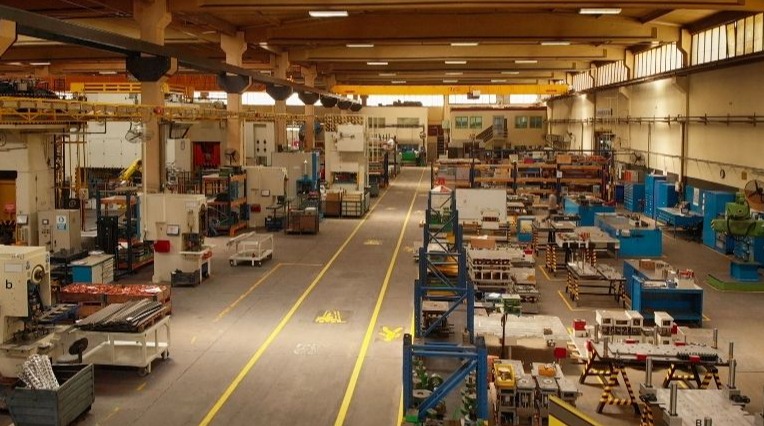
In industries and operations that involve intense materials management demands, such as warehousing, manufacturing, and hospitals, every misplaced pallet, unaccounted-for surgical tray, or delayed component can cascade into costly downtime; in this climate, accuracy and speed are non-negotiable.
These businesses often have inherent material challenges: warehouses battle shrinking margins from inventory discrepancies, distribution centers struggle with order-fulfillment velocity, manufacturing floors contend with just-in-time supply-chain fragility, or hospitals face regulatory pressure to maintain unbroken chains of custody for high-value assets. Often, traditional barcode scans and periodic audits cannot keep pace with today’s 24/7 operations.
At Straight Line Solutions, we have spent more than two decades serving as strategic partners for these exact environments. Through specialized consulting and precise materials specification, we help organizations move beyond reactive tracking to proactive, data-driven control. One of the most powerful advances we guide clients toward is the seamless integration of Internet of Things (IoT) sensors with Real-Time Location Systems (RTLS). Together, these technologies deliver unprecedented visibility, turning raw location data into actionable intelligence that reduces loss, accelerates workflows, and strengthens compliance.
Understanding the Building Blocks
IoT sensors are compact, network-connected devices that continuously capture environmental and operational data. A typical IoT sensor in a materials-management setting might monitor not only position but also temperature, humidity, shock, or battery status. Because these devices communicate wirelessly — often over Wi-Fi, Bluetooth Low Energy (BLE), or cellular networks — these sensors can feed live information into centralized dashboards or warehouse management systems (WMS) without requiring human intervention.
RTLS, by contrast, answers the critical question “Where is it right now?” with centimeter-level precision. Common RTLS technologies include:
- Ultra-Wideband (UWB) for high-accuracy indoor positioning (often ±10 cm)
- RFID (active or passive tags) that leverage existing reader infrastructure
- BLE beacons or Wi-Fi triangulation for cost-effective coverage across large footprints
- Hybrid systems that combine multiple signals for redundancy and reliability
When IoT sensors are paired with RTLS infrastructure, the result is a living digital twin of your inventory and assets. A pallet tag reports not only its aisle and bay but also whether the load has experienced excessive vibration during transit or if refrigerated goods have drifted outside safe temperature thresholds.
Real-World Impact Across Industries
Consider a large distribution center handling thousands of SKUs daily. Manual cycle counts might reveal a 2–3% shrinkage rate after-the-fact. With RTLS-enabled IoT tags, the same operation gains continuous visibility: forklifts automatically update stock locations as they move, and geofenced alerts notify supervisors the instant high-value items leave a designated zone. The outcome? Shrinkage drops below 0.5%, labor previously spent on searches is redeployed to value-adding tasks, and carrier compliance improves because proof-of-condition data travels with every shipment.
In manufacturing, just-in-time (JIT) production lives or dies by component availability. IoT-RTLS solutions let planners see exactly where a die, tool, or sub-assembly sits on the shop floor. Predictive analytics layered on top of this data can flag when a critical jig is drifting toward a high-traffic aisle, prompting proactive relocation before it becomes a bottleneck. The result is measurable gains in overall equipment effectiveness (OEE) and fewer expedited shipments.
Hospitals present a different but equally compelling use case. High-value assets such as infusion pumps, crash carts, and portable imaging equipment must be located instantly during emergencies, yet they frequently migrate between departments. Lack of tracking ability can often spur hospitals to purchase additional units at great cost simply to avoid the crises that may arise if equipment isn’t locatable when needed. But RTLS badges and IoT sensors attached to these devices can create perpetual inventory loops. Clinical engineering teams receive utilization analytics that inform preventive maintenance schedules, while infection-control protocols benefit from automated dwell-time reporting. The benefit is operational efficiency, enhanced patient safety, and better cost-effectiveness.
Overcoming Implementation Hurdles
Sophisticated operators already know that technology alone does not guarantee success. Integration with legacy WMS or ERP platforms, data-security requirements, and ROI justification are perennial concerns. Here is where Straight Line Solutions’ consultative approach proves decisive.
We begin with an on-site assessment to evaluate your specific RF environment, layout density, and workflow choke points. Rather than proposing a generic “one-size-fits-all” kit, we specify the precise mix of tags, readers, antennas, and mounting hardware that matches your facility’s realities.
We also address scalability from day one. A pilot in a single warehouse zone can expand facility-wide or across an entire enterprise because the architecture we recommend supports cloud-edge hybrid processing. Data sovereignty, encryption, and role-based access controls are baked into the design, satisfying regulatory and industry requirements as needed.
Quantifiable Returns and Emerging Capabilities
Clients who adopt IoT-RTLS under our guidance have the ability to realize significant gains:
- Reduction in search-and-retrieve labor
- Improvement in inventory accuracy
- Faster order cycle times
- Decreased insurance premiums due to documented chain-of-custody and condition monitoring
- Enhanced sustainability metrics through optimized routing that lowers unnecessary forklift travel
At the moment, the convergence of IoT, RTLS, and artificial intelligence is accelerating. Machine-learning models trained on historical location and sensor data can predict stock-outs before they occur, recommend dynamic slotting adjustments, or even trigger autonomous mobile robots to retrieve items. Organizations that treat tracking as a strategic capability — rather than a cost center — will be able to lead their markets in responsiveness and resilience.
Taking the Next Step
The transition to smarter material tracking does not require a complete rip-and-replace of existing infrastructure. It does, however, demand expert guidance to ensure the chosen sensors, tags, readers, and software mesh seamlessly with your operations and deliver measurable ROI from the outset.
If your organization is ready to replace guesswork with real-time intelligence, the Straight Line Solutions team is prepared to help. We offer facility assessments, proof-of-concept deployments using test hardware, and detailed materials specifications tailored to your operation’s unique challenges.
Contact Straight Line Solutions today to schedule a consultation or request a site survey. We would be happy to show you how IoT sensors and RTLS — properly specified and expertly implemented — can turn your materials-management operation into a competitive advantage rather than a source of friction.